Use-case guide
Stress relief toys: find the right fit for your routine
The best stress relief toy is not necessarily the softest, biggest, or most viral one. It is the one you can use comfortably in the moment you actually have. Compare the main options, then decide whether a finished toy or a printable craft better matches the job.
- Start with
- Where, when, and how long
- Check
- Noise, grip, texture, and cleanup
- Paper route
- A short creative reset
Start with the situation, not the product category
A work-desk tool needs to be quiet and compact. A travel tool needs to survive a bag and be easy to wipe. A home object can be larger or more tactile. A classroom activity needs clear materials, age-appropriate cutting, and a cleanup plan. The setting is more useful than a generic promise that a toy will make everyone feel better.
Stress relief is also a broad phrase. A toy may help a person occupy restless hands or create a short routine, but it does not treat anxiety, depression, panic, or chronic stress. If stress keeps disrupting sleep, work, relationships, or daily life, a toy should be one small support at most, not the whole plan.
Compare common options honestly
Stress balls offer a straightforward squeeze and are easy to explain. Fidget tools provide movement such as rolling, flipping, or clicking, but their sound may not fit a shared room. Putty adds resistance and creative manipulation but needs a clean container. Plush and slow-rise shapes offer a softer, slower interaction, while paper crafts add a making step instead of instant tactile feedback.
The best choice is often the one with the least friction. If you will not carry it, clean it, or use it in the room where you need it, the theoretical texture does not matter. Try one object for a short period and notice whether it supports focus, irritates your hands, or simply becomes another thing to manage.
- Quiet desk: smooth squeeze, fabric, or paper craft.
- Creative reset: printable pattern, coloring, or a simple build.
- Strong hand input: a firm object that does not cause pain or strain.
- Shared spaces: avoid noisy parts, loose pieces, and hard-to-clean materials.
A paper squishy can be a useful pause
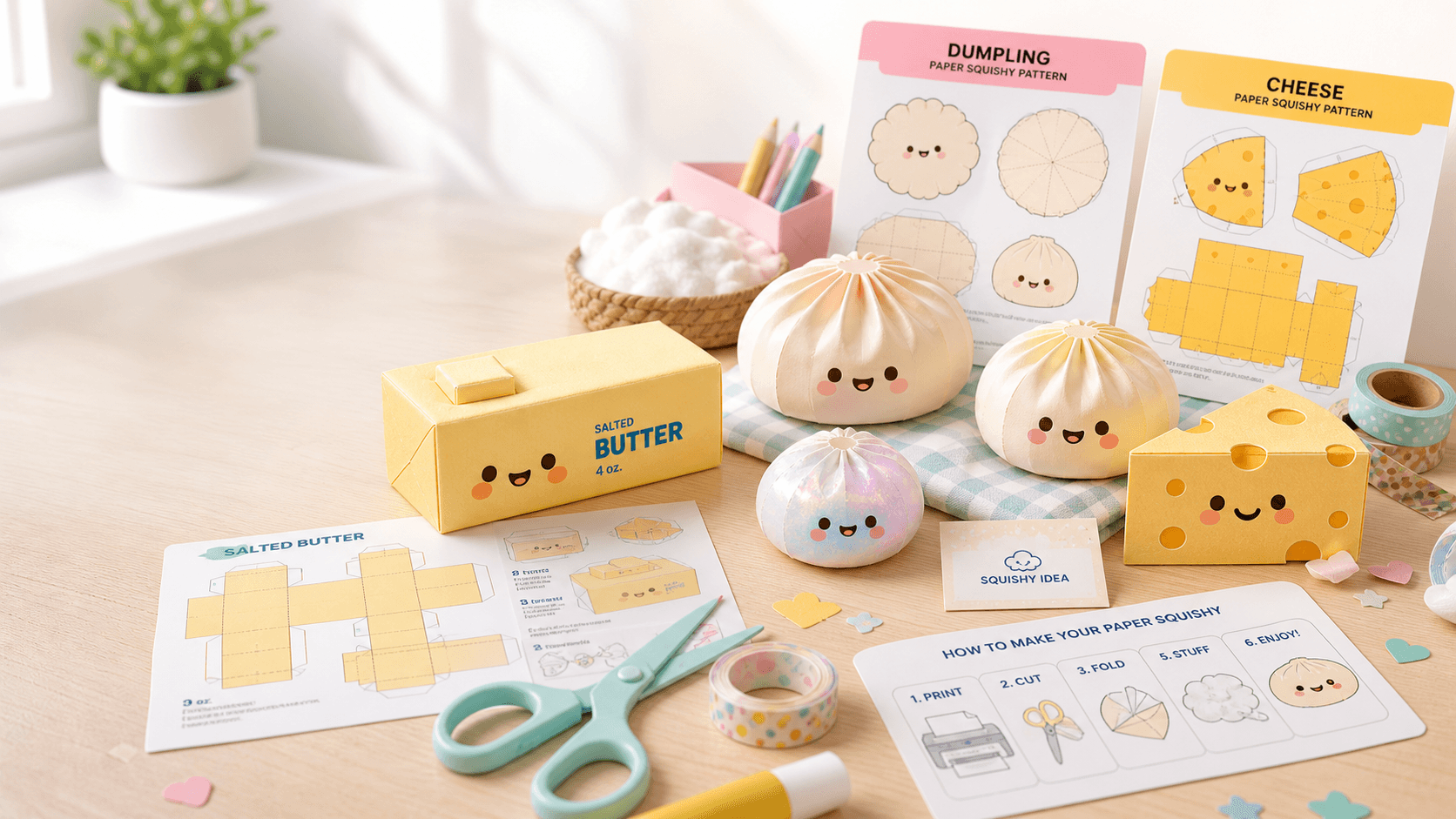
Paper squishies take longer than a squeeze ball because you make them. That is the point. A 20–30 minute project gives your attention one small sequence: print, decorate, cut, fill, and seal. You end with something visible rather than an empty break that disappears as soon as you return to the screen.
Keep it light. Use ordinary paper for the first attempt, add tissue in small pieces, and stop when the shape has a little give. The craft is most satisfying when the edges stay neat and the maker can see what changed at each step.
A practical way to start
- 1
Pick the moment
Name the desk, classroom, commute, or home routine where the tool will be used.
- 2
Pick the input
Choose squeeze, movement, texture, or a creative process instead of buying by trend alone.
- 3
Run a short test
Use it for five minutes and check comfort, noise, focus, and cleanup.
- 4
Review honestly
Keep the tool only if it makes the moment easier; switch or pause when it does not.
Common questions
What is the best stress relief toy?
There is no universal best choice. Match the toy to the setting, the preferred sensation, the amount of noise, and the person’s ability to use and clean it safely.
Are squishy toys good for stress?
Some people enjoy a soft squeeze or repetitive movement during a short stressful moment. The effect varies, and a toy is not a treatment for a health condition.
What is a low-cost alternative to a stress toy?
A printable paper craft, a smooth household object used safely, or a short movement break may be lower-cost options. Keep any children’s activity age-appropriate and supervised.